The following post is an opinion piece that I wrote in my capacity as Digital Program Officer for the Australia Council for the Arts (2009-2011). It was first published through artsdigitalera on 21st September 2010 and is re-published here with permission.
 As the Digital Program Officer at the Australia Council for the Arts I am charged with exploring existing and future technologies to assist and encourage development across the Australian arts sector. I specifically examine the barriers and opportunities that exist for artists and organisations trying to come to terms with these new tools. By the end of the 2010/11 financial year the digital program will have invested around $2.3million into Australia’s digital arts economy. Not just into media arts, but across visual arts, literature, theatre, dance, interdisciplinary, community, music and the major (also described by some as ‘Heritage’) companies.
Having personally explored the international media arts space since the mid ‘90’s, I can honestly say I feel pretty ‘heritage’ myself at the moment. My personal transition took me from theatre (where I was a stage manager, prop maker and general all-hands-on-deck crew for around a decade) to interactive multimedia production. To me this was a seamless, obvious, step. Performance has always been innovatively engaged with technology, from the more experimental multimedia performance art through to more traditional lighting, set and sound designs we’ve come to expect from an ‘average’ stage show.
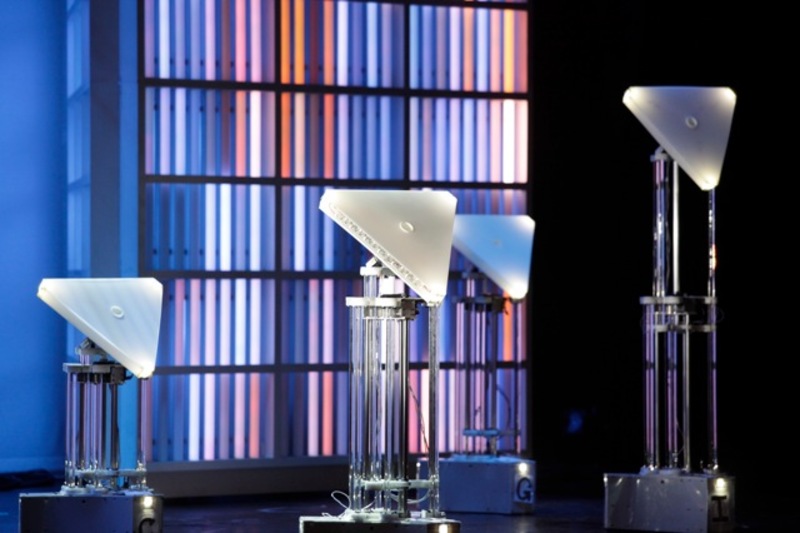
Death and the Powers, MIT Media Lab
Josef Svoboda’s early mechanical staging designs including the 1958 Polyekran; Tod Machover’s 1996 Brain Opera or his brand-new Death and the Powers; Robert Lepage’s use of cameras on stage during 1995 Elsinore (or pretty much anything he’s done); William Kentridge’s 2005 cinematic Magic Flute… the list could so easily go on. My point is that theatre alone is awash with digital experimentation and innovation. It’s the reason I loved it so dearly back then – and still do now. So, why did I move from Theatre to Media Arts? Because financial support for the kind of productions I wanted to create or be part of didn’t exist in the UK at the time I left college. And the internet was just starting to emerge.
I found the internet a pure marvel. It was everything unknown and experimental that I loved about theatre. It contained the potential for a similar kind of audio/visual/narrative engagement, but with the added dimension of interactivity, not to mention enormous geographic reach. As a producer I could offer a multitude of experiences to people in different places at the same time. I could begin an event and not know myself how it would end. That’s what makes media art so exciting.
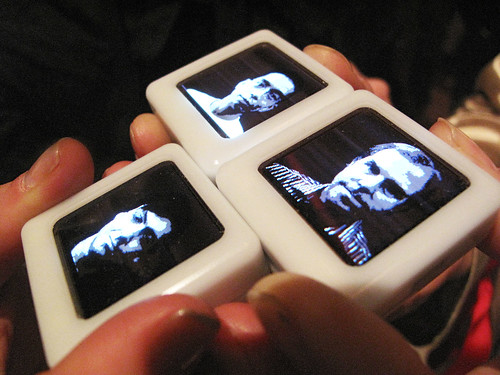
Siftables, tiny computers that speak to each other
I prefer to use the term ‘media art’ over ‘new media’ these days, because I feel the latter gives the wrong impression. When we say new media, we don’t mean ‘done for the first time’, we mean ‘done in a way that is slightly different to how it was done before’. New media is ‘new’ only in the sense that it is always evolving. No one I have ever worked with in the digital space has ever had the arrogance to declare honestly that what they are doing is ‘new’. We all stand on the shoulders of giants, despite several industries’ demands to the contrary.
Digital is not a new artform; it has the ability to immerse you in within many different artforms. Media art is not trying to kill any other artform; it’s trying to augment and feed all of them. It’s not your enemy; it’s trying to let you tell it how to be its friend. It makes no demands; it only wants to play.

Stephen Fry’s interactive iPhone novel
Contemporary audiences actively want to play. They demand a more personalised, interactive engagement. They want to play where and when they’re ready to, and don’t always mind whether or not it takes place in a beautiful heritage listed building. Sure they love to go to gorgeous buildings too, sometimes, but why limit exposure to just that one physical space? This is exactly why we’re watching the convergence between art, game, internet, film, TV, fashion, etc. Creativity which is not restricted to a building becomes a live dynamic experience that can be experienced on a games console, in a cinema, or even worn as a fashion accessory. Your smartphone doesn’t care that the experience you’re connected to was made by someone who calls themselves a games designer or a sculptor; why should we be so hung up on a label? Creative people do not close the door on imagination, why would you close the door on platform?
Without an unending search for the key to the secret of creativity, there is no creation. It’s necessary always to begin again. And that is beautiful.” – Josef Svoboda.
Through the digital program, we’ve been able to support independent artists; some known to us and others who have never come to the Australia Council before. The Digital Culture Fund found a gap somewhere between research and prototyping, where an artist can come with a notion of an engaging idea and use the fund to help find out what that looks like in reality. The results we’re seeing from last year’s pilot shows art in spaces like Roller Derby tournaments and on iPhones, using motion capture for live animation, or racing around on car tracks made of recycled vinyl records. There’s a second call for this happening right now, by the way. The Geek in Residence program has connected enthusiastic geek expertise with arts organisations who literally don’t know where to start. We’ve brought rights experts together to discuss what to do about a legal system designed for a different age, and recognised the huge threat of a digital dark ages with regards our lack of accessible archives.
From the major performing arts budget, we’ve connected independent media artists with large ‘mainstream’ companies, sharing the old and the new, blending the big and the small. We have educated companies in methods for approaching digital education, and helped them prototype new innovations which extend their physical touring capacity. We’ve empowered practitioners to transform an Indigenous cultural experience into an interactive digital engagement. We’ve partnered in a three-year research program to create and analyse an experimental prototype for an online participatory ‘living archive’. Oh and thrown in a couple of Geek in Residence placements while we’re at it.

Understanding Shakespeare: The Visual Form of Text and Language
I therefore simply do not understand this ‘heritage versus digital’ angle which is too often being thrown around in the media and blogosphere recently. No one is suggesting that we burn our books just because we have iPads. Equally media art – a respected international movement – should not be dismissed, as one commentator, did, as ‘meretricious, self-serving clap-trap’.
I have spent my career taking a traditional quality craftsmanship approach to new and emerging platforms and practices. The expertise of a jeweller or a games designer can hold more value to me personally than a piece of music that hasn’t been presented to my ears in a way that excites me. Sure, not all creative practice resonates with every individual, but please do not assume that one art form stands above any other. Not all media artists are experts, just like some performers fluff their lines. And just because technology is described as time-saving, do not assume that a digital practitioner has not dedicated their life to producing perfection in their field.

geek jewellery

ring watch
We know globally that there is not enough cultural subsidy to go around. But artists through the ages have learned to make do, often displaying great innovation in the process. As I explained to a group of gamers who complained about having to jump through arts hoops to access arts funding, berating why there wasn’t enough funding more broadly for their industry; we’re changing the world here! Change takes time. And subsidy responds to change, it never pre-empts it.
More than ten years ago the major performing arts companies collaborated on a campaign which fought to protect their art form sector, and we should admire them for their resulting success. These 28 companies are now funded by the decisions of the cultural ministers of all the Australian governments. This is entirely separate from the funding which the Australia Council administers for all other artforms which – yes – is a much smaller pie. This has sadly resulted in a lot of ‘us and them’ battling. The rise of digital platforms and interactive engagement does not – or should not – herald the end of anything which came before it. Video did not kill the radio star, and digital will not kill the opera or orchestra.
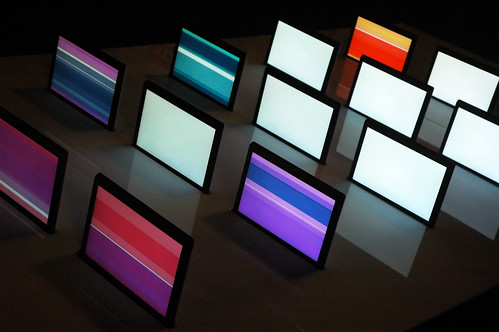
Laptop Orchestra at Wired NextFest
What’s being fundamentally missed in this battle over budgets is what lies at the heart of the digital experience. An interactive, pervasive experience which is tuned to you, personally, is a sensation not to be missed. The collaboration and community connection you get when you’re all sharing exactly the same experience, from an entirely different location and in a slightly different way… it makes me tingle just thinking about it. Digital enhances everything, not by what it is but by how it functions. The geek world is truly astonishing, and if you don’t understand that, or you’re blocking it for whatever reason, then you’re really missing out on something wonderful.
I suggest we stop this ‘us and them’ battle and instead work together collaboratively to build a sustainable cultural future. Who knows, maybe some rich contemporary experimentation across all art forms now will result in the heritage culture of the future.
– –
Comments taken from initial post:
Submitted by Andrew Brown on 28 September 2010 – 3:36pm.
A very sensible piece Fee. Pluralism and respect should trump parochialism, envy and ignorance.
Digital technologies offer great creative possibilities and I for one am excited about exploring them, especially outside of debates about high/low and popular/unpopular.
Its unfortunate that in a scramble for the limited resources that support arts activities people often highlight differences.
Submitted by fee on 28 September 2010 – 4:08pm.
Thanks Andrew. We can’t blame people for getting cross, I just feel we shouldn’t turn on each other. It especially breaks my heart when the geek world is just such a joyous place to be – whatever art form world you come from!
Ahh well… we can but hope :)
Submitted by Scott Walker (not verified) on 21 September 2010 – 2:26pm.
So, to sum up:
1) digital = different
2) different <> bad
[therefore]
3) digital <> bad
Sounds logical to me…
Submitted by fee on 21 September 2010 – 2:34pm.
heh, thanks Scott. i’m especially grateful for the follow up tweet (@scott_walker) where you gave me the free geek tip explanation :)
<> is a logical set of characters that means “does not equal”
imho, different=awesome!