#hammocktime #WOMADelaide word cloud

I just shared the first #hammocktime output over on my blog and the facebook page for that project. Instead of just re-blogging that same post here I wanted to say something about the experience as a whole.

all the words that were contributed across all three questions:

all the words that were contributed across all three questions

In light of the consistent bullshit going on in the world (especially in Australia’s part of the world) this little ‘active questioning’ project in amongst the glorious already-get-it WOMADelaide​ community does nothing to change anything. But it’s a start.

hammocktime is my first personal work where I actively step up and start dialogue within the experience itself. It’s a reminder for others that they’re not alone, that WE are not alone. It speaks to what I have learned in my life as a whole, but specifically what I have learned through my own “lifestyle choice” of nomadicy, choosing to live in a bus instead of maintaining a proper job and a proper home. #buslife is not always easy but it always teaches you something if you are prepared to listen. I have had the most incredible amount of support and advice getting me through this transition from so very many people. I’m super grateful for the opportunity and will never forget the crowdfunding campaign contributors and everyone who has enabled all this to happen. hammocktime is just the first reveal of the tendrils from these past three years’ learnings, and for that I am pretty proud. But it’s far from the end.

In order for real change to take place we need to be kind to ourselves, to reconnect with ourselves, with the land and with others. Hammocks are an act of self-kindness, taking time out for oneself without distraction (especially by banning mobile devices from them!). Providing a meditation experienced whilst suspended in trees rooted deeply within land (once home to a people far far older than my own culture) delivered by a human not a set of headphones, meant something. The active questioning, those three simple questions, are my way of bringing all that loveliness into a focused form, an output that can be shared. Dropping them in to a word cloud is such a simple device but it spreads a cluster of positive energy out there, which we all need as times get increasingly darker.

Presenting this version at WOMADelaide was just the start, I’ll be taking the project to different communities and repeating the same questions. The easiest thing in the world would be to continue targeting like-minded communities and festivals, but I’ll be working to break out of that safety zone. Busking hammocktime in various forms during my Perth residency with cia studios taught me a lot about arts and non arts audiences, activist and non-activist campaigners. I’d like to gather as much of a diversity as I can possibly make happen.

Let’s reclaim the world. Now.

x

your #WOMADelaide #hammocktime invitation

hammocktime invites WOMADelaide guests to pause, disconnect from technology and reconnect to yourself and your environment by spending twenty minutes in a hammock.

Your first few minutes will be spent in a gentle guided meditation, followed by ten minutes of private pause.

“Take a moment to locate yourself. Not just at WOMADelaide, but right here, right now.

In this hammock. In this tree. In this moment”.

your view from the hammock

The form of meditation we use to get you in the right mood is inspired by British philosopher, Alan Watts, who says, “The art of meditation is the art of getting in touch with reality… by going out of your mind, you come to your senses“.

During your pause we ask you to consider your own reality and come up with one word that responds to each of the following questions:

  • What would make your vision of the world a better place?
  • What personal action could you take that would lead to that change?
  • What collective action could we take that would lead to that change?

All answers will be collected at the end of each session and presented online in datavisual form.

You will find us in The Pines area near the Healing Village, just look for #homeJames, the beautiful big red bus.

Friday 6th March: 4:30pm – 8pm
Saturday 7th March: 2pm – 8pm
Sunday 8th March: 2pm – 8pm
Monday 9th March: 2pm – 8pm

#homeJames at The Pines in WOMADelaide

Your guides in this journey are Fee Plumley, Anna Crump, Calixta Cheers, Indigo Eli, Kim Pedler, Steven Abbey, Scott Wings and Manal Younis. Huge thanks to WOMADelaide for giving us such a perfect context in which to provide this experience, and to Ticket to the Moon who provided our beautiful, ethically produced, hammocks.

Thank you for sharing your hammocktime with us x

#hammocktime

http://hammocktime.cc

http://twitter.com/feesable

http://facebook.com/hammocktime.cc

WOMADelaide map

this post was originally posted by http://hammocktime.cc

a call for common land for nomads

A few weeks ago I saw this article http://www.ntnews.com.au/news/our-parks-awash-with-freeloading-backpackers/story-fnjbnts7-1227197443051 and immediately thought: “wicked, I’ve been wanting to have a discussion about this for ages!”

NB: I originally posted this in my lateral drifts blog where I drop down random thoughts as I’m mulling them over. This one turned out detailed enough to just transcribe here. Please feel free to comment/share, I’d really love a big chat around all these issues, especially if you’ve got good suggestions for better ways of living a nomadic life (and free park ups which don’t piss anyone off and aren’t illegal – there are very few of them these days). And if you fancy joining the ‘Common Land‘ cause, get in touch!

So… nomads. Are we “freeloaders” or cultural explorers? The case for nomadicy…

first: not all of humanity wants to live in a corporate world. we don’t all want the threat of a mortgage hanging over our heads (in fact very few even can get such things without rich parents taking up the slack). we also don’t want/can’t afford to live in holiday parks – sure some of these are holiday travellers, but some of us are fulltime nomads. we need access to free camps, common land, which we use in return for taking responsibility for them (because we do actually care about the environment, that’s one of the reasons we choose to live this life, off-grid and self-sustaining).

as mentioned in the article, most of us choose parkups that are away from residential areas so we won’t bother anyone, but even they are becoming privatised. and yes, we do congregate sometimes when we’re travelling round – who doesn’t want a social life? why should that social life exist in pubs and clubs? some of us don’t drink and are far from interested in yet another commercialised environment.

when gathering we all learn from each others’ bus/van designs, share good places to park (which don’t piss anyone off and aren’t illegal) and generally learn more about the world through the eyes of other open-minded cultural explorers. it’s the absolute best way to see this incredible country!

#homeJames has a doppleganger!

second: public toilets get locked up around 7pm in Australia. sure it’s horrid when someone craps on your doorstep (and personally I can control my bowels so I don’t have to do this unless I’m out bush, in which case I have a shovel for that!), but if the toilets weren’t locked overnight this wouldn’t have to happen. also bear in mind that this might not always be the campers – when I lived in Sydney there was an old homeless woman (clearly ignored by any welfare/care system) who used to crap in my porch on a regular basis. and we all know about men relieving themselves in doorways – or anywhere they like! it’s not just nomads who do this, some people are just jerks.

third: it makes me really mad when I see ANYONE littering. we all have a responsibility to our/other people’s environments as well as the planet itself. littering is lazy and thoughtless (whether it’s rubbish or cigarette butts, in fact especially cig butts considering their fire risk and chemical waste). but I’ll bet you have a crappy neighbour who has piles of junk outside their homes or lets their rubbish blow all over the roads. i regularly see drivers/walkers throw butts/rubbish onto streets/pavements: again, it’s not just nomads who litter, some people are just jerks.

in fact at a lot of the places where I parkup by the sea, it’s the fishermen who leave junk (beer bottles, food packaging and even hooks) behind them. providing more bins isn’t always the answer either. I’ve known part-timers complain about there not being a bin at an overnight roadside stop, FFS just take it with you and throw it away (in recycling bins) in town! or better still, reduce your use of packaging entirely so your waste is minimal!

fourth: ‘wearing their underwear’… really?! this is Australia, the whole damn country wears its underwear (aka ‘bikinis and budgie smugglers’) every damn day!! so, yet again, it’s not just nomads who do this!

fifth: washing/brushing teeth – we all have to keep ourselves hygienic. spitting toothpaste or soapy water (onto grass, not pavements) is less of an issue for me when those products aren’t full of chemicals. I use Eco or natural alternatives – I brush my teeth with coconut oil most of the time. water evaporates (or in fact adds moisture to dry ground) and even businessmen spit much worse stuff from their mouths walking down city streets. so, again, it’s not just nomads who do this!

sixth: hanging laundry from trees – I handwash or use a launderette washer then hang my clothes up in the bus (in this heat they dry v quickly) but then I have a reasonably sized vehicle. I’ve seen families at public parks hanging their own tea towels etc up on makeshift lines. what’s the harm in that? and again, not just nomads…
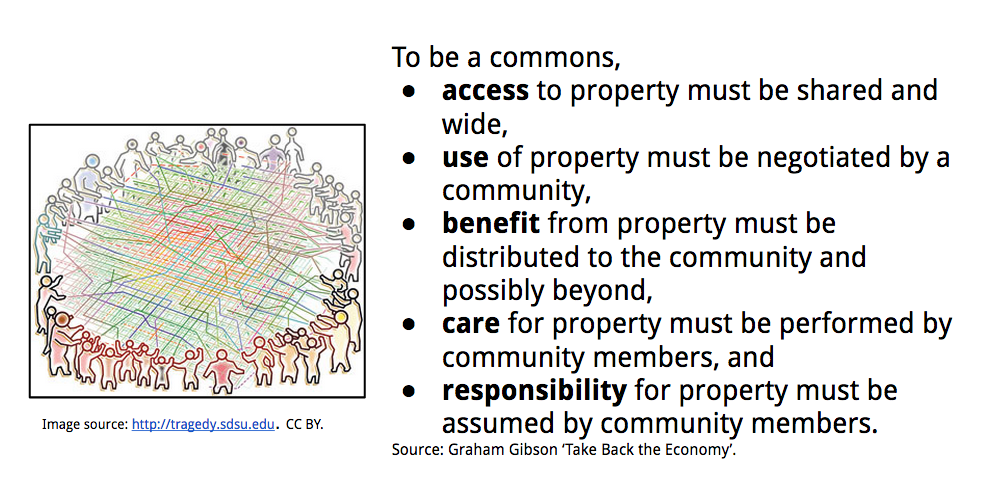
slide I used for a talk recently,  quoting https://www.upress.umn.edu/book-division/books/take-back-the-economy

slide I used for a talk recently, quoting https://www.upress.umn.edu/book-division/books/take-back-the-economy

so, by all means dismiss us by calling us names like ‘freeloaders’ but be aware that  some humans are jerks regardless of their choice of home or lifestyle; don’t just tarnish us all with the same brush. maybe try to talk to us instead of reporting us to council/police – we’re actually quite personable folk and we’d certainly enjoy an open discussion (no one takes kindly to threats or abuse, so ideally don’t start with that). maybe we could even change each others’ stereotype projections and learn to accept otherness a little more, that wouldn’t do our society much harm, now would it?

bear in mind a nomadic life is not always easy, and it’s certainly not always a holiday for those of us who live this way all year round. we have made this choice, sacrificing ‘the easy life’ because we believe in a better world, one that is not driven by consumerism or the daily commute to provide profit to our bosses’ shareholders. some of us do work in ‘normal’ jobs but most are freelance – and we all pay our taxes like regular folk. some of us aren’t even on the dole! (I know, *gasp*).

and FFS… GIVE US ACCESS TO COMMON LAND! not every single block of our existence needs to be commercialised. if you just give us a place where we can do our thing, we’ll be out of your hair!

on loneliness and art

Fascinating connection btw loneliness and art – rings so true for nomadicy

Reading this: http://aeon.co/magazine/culture/olivia-laing-me-lonely-in-manhattan/

“Something funny happens to people who are lonely. The lonelier they get, the less adept they become at navigating social currents. Loneliness grows around them, like mould or fur, a prophylactic that inhibits contact, no matter how badly contact is desired. Loneliness is accretive, extending and perpetuating itself. Once it becomes impacted, it isn’t easy to dislodge.

“It seems that this is what loneliness is designed to do: to provoke the restoration of social bonds. Like pain itself, it exists to alert the organism to a state of untenability, to prompt a change in circumstance. We are social animals, the theory goes, and so isolation is — or was, at some unspecified point in our evolutionary journey — unsafe for us.”

I struggle often with loneliness which can so easily bleed in to depression before you’ve even noticed.

Disconnection is just one of the many challenges of a nomadic life. So many people assume buslife is a constant holiday. It’s rich and beautiful and rewarding in so many ways, but with so many disconnections and instabilities I often wonder if it’s psychologically healthy :/

Seriously grateful to the people all over the world who understand this and offer love, kindness, patience & virtual or physical (especially physical!) hugs during those times. You know who you are. I love you with all my heart. Thank you x

[originally posted in Known, February 9th 2015]

enclosure

I have become increasingly obsessed by The Commons and the freedoms which have been taken from humans all over the world, because: profit.

Since colonisation Australia has never recognised common land, despite otherwise adopting pretty much all of England and Wales’ legal systems. Aboriginal Australians, on the other hand, fully understand the importance of being responsible -and sharing responsibility- for the land and each other.

‘enclosure’ is a new (work-in-progress) live art performance I’ve been playing with which stems from this obsession. It can be delivered as a one-to-one or group experience.

This is the first of my projects exploring this concept and attempting to reframe our society’s obsession with ownership.

See below for some great photos from the Kiss Club event in December 2014. Kiss Club is an incredible opportunity to trial new works-in-progress with an audience who not understand the context of ‘messy space development’ but also provide feedback after experiencing it – gold! Pictures are (c) the owner and republished with permission from Amber Bateup and Tarryn Runkel.

Major kudos to Kaz Therese for the Kiss Club concept and to cia studios for hosting me there.

'enclosure' at Kiss Club, Dec 2014. (c) Amber Bateup

UPDATE April 2016: This post by Joe Brewer, “The Global Architecture of Wealth Extraction“, explains Enclosure in far better, more articulate, specific detail than I ever could. A fantastic read… with infographics!